How to Create a Journaling Ritual You Actually Enjoy
Journaling doesn't have to mean sitting down every morning with pages of perfectly written thoughts. It can be a simple, calming ritual that gives you a few moments to slow down, reflect and reconnect with yourself.
The key is to create a journaling ritual that feels enjoyable rather than another task on your to-do list.
Whether you prefer writing in the morning, reflecting before bed or simply reaching for your journal when you need some quiet time, a few small habits can help make journaling something you genuinely look forward to.
What Is a Journaling Ritual?
A journaling ritual is a regular moment you create for yourself to write, reflect and check in with how you're feeling.
Unlike simply writing in a notebook whenever you remember, a ritual adds intention and consistency.
Your journaling ritual might include:
Making a cup of tea
Lighting a candle
Playing calming music
Choosing a comfortable place to sit
Using a favourite journal and pen
Holding a crystal that represents your intention
Writing about your thoughts and feelings
Finishing with gratitude or an intention
There is no single right way to journal. The most meaningful ritual is one that feels natural to you.
Why Create a Journaling Ritual?
Journaling can give you space to pause in a busy day and pay attention to what's happening within you.
A regular practice can help you:
Reflect on your thoughts and experiences
Notice patterns in your everyday life
Explore your goals and intentions
Express thoughts you may not feel ready to say out loud
Practise gratitude
Make time for yourself
Become more intentional about your day
You don't need to write pages every day. Even five minutes can create a valuable moment of reflection.
Choose a Time That Feels Natural
The best time to journal is the time you're most likely to enjoy and maintain.
For some people, morning journaling feels like a peaceful way to begin the day. For others, evening journaling provides an opportunity to reflect and let go of the day.
Try asking yourself:
When do I naturally have a few quiet minutes?
You might choose:
First thing in the morning
During your lunch break
After work
Before bed
Sunday evenings
Whenever you feel like you need to reconnect with yourself
Don't worry about choosing the "perfect" time. Choose a time that works for your life.
Create a Comfortable Journaling Space
Your environment can make a big difference to how your journaling ritual feels.
You don't need an entire room dedicated to journaling. A small corner of your bedroom, living room or desk can be enough.
Make your space feel inviting with things you enjoy.
You could have:
Your favourite journal
A comfortable cushion or chair
A candle
A cup of tea
A small plant
A meaningful object
Your favourite crystal
The goal isn't to create a picture-perfect space. It's to create somewhere that encourages you to slow down.
Choose a Journal You Love Using
Your journal doesn't need to be expensive or elaborate.
But choosing a notebook that you genuinely enjoy can make you more excited to use it.
Think about what feels right for you.
Do you prefer:
A simple notebook?
A guided journal?
A lined journal?
Blank pages?
A smaller journal you can carry with you?
A beautiful journal that feels special?
Choose something that makes you want to open it.
The same applies to your pen. If you love writing with a particular pen, keep it with your journal so everything is ready when you sit down.
Make Your Journaling Ritual Your Own
There are no rules saying that journaling has to look a certain way.
Your ritual could be five minutes of free writing or thirty minutes of thoughtful reflection.
You might start with a simple question:
How am I feeling today?
Then write whatever comes to mind.
You don't have to make your writing sound beautiful. You don't need perfect grammar. Your journal is for you.
Let yourself write honestly and without worrying about how the words look on the page.
Try Journaling Prompts
Sometimes the hardest part of journaling is knowing what to write.
This is where journal prompts can help.
Try questions such as:
What do I need more of in my life right now?
What am I grateful for today?
What is currently taking up most of my thoughts?
What would make today feel meaningful?
What am I ready to let go of?
What is something I want to understand about myself?
What intention do I want to carry into tomorrow?
You don't have to answer every question. Choose one that catches your attention and start there.
For more inspiration, explore our guide to 20 Journal Prompts for Self-Discovery and Inner Growth.
Add a Little Mindfulness
Before you begin writing, take a moment to arrive where you are.
Put your phone aside, take a few slow breaths and notice how you're feeling.
You could spend one minute simply sitting quietly before opening your journal.
This can help create a clear transition between the busyness of your day and your journaling time.
Your ritual doesn't need to be complicated.
Sometimes the simplest moments are the most meaningful.
Include Gratitude
Gratitude can be a lovely addition to a journaling ritual.
At the beginning or end of your writing session, note three things you're grateful for.
They don't have to be major events.
You might write:
A peaceful cup of tea
A conversation with someone you love
Sunshine through the window
A walk outside
Having a quiet moment to yourself
Over time, this can encourage you to notice the small moments that make your everyday life meaningful.
You can also explore more ideas in our guide to 10 Simple Gratitude Practices for Everyday Life.
Use Crystals as Part of Your Ritual
If crystals are part of your spiritual practice, you can incorporate them into your journaling ritual as a visual reminder of your intention.
For example, you might choose a crystal based on the quality you want to focus on during your journaling session.
Some crystals are traditionally associated with different intentions, such as:
Rose quartz — love and compassion
Amethyst — calm and spiritual reflection
Clear quartz — clarity and intention
Citrine — positivity and confidence
Black tourmaline — grounding and protection
These associations come from spiritual and crystal traditions rather than established scientific evidence.
You could simply place your chosen crystal beside your journal while you write.
The crystal doesn't need to do anything. It can simply act as a physical reminder of the intention you've chosen for yourself.
Put Your Phone Away
One of the simplest ways to make journaling more enjoyable is to remove distractions.
Try putting your phone on silent or leaving it in another room while you journal.
Even ten minutes without notifications can make your journaling time feel more intentional.
Think of it as creating a small pocket of uninterrupted time for yourself.
Don't Force Yourself to Write Every Day
Consistency can be helpful, but journaling doesn't have to become another obligation.
If you miss a day, don't feel like you've failed.
You can journal three times a week, once a week or whenever you genuinely need the space.
The purpose of a journaling ritual is to support you, not create another thing to feel guilty about.
Focus on creating a practice you enjoy returning to.
Create a Simple Journaling Ritual
If you're not sure where to start, try this simple five-minute ritual.
Your 5-Minute Journaling Ritual
Step 1: Create a calm space
Put your phone away and sit somewhere comfortable.
Step 2: Take three slow breaths
Allow yourself to slow down before you begin.
Step 3: Choose one intention
Ask yourself:
What do I need from this moment?
Step 4: Write for three minutes
Don't overthink it. Write whatever comes to mind.
Step 5: Finish with gratitude
Write down one thing you're grateful for today.
That's it.
You don't need a complicated routine to create a meaningful journaling practice.
Make Your Journaling Ritual Something You Look Forward To
The most important part of creating a journaling ritual is making it enjoyable.
Think about the little things that make you feel calm and comfortable.
Perhaps you love a particular tea, candle, playlist or cosy blanket.
Bring those things into your ritual.
You could even create a small journaling basket containing your journal, favourite pen, candle and anything else you like to use.
When everything is together, it becomes easier to create a sense of ritual.
Let Your Ritual Change With You
Your journaling practice doesn't have to stay the same forever.
There may be times when you want to write about goals and future plans.
Other times, you might need space to process your emotions or simply record what happened during your day.
Allow your ritual to change depending on what you need.
Your journal can become a place to check in with yourself throughout different seasons of life.
How Often Should You Journal?
There is no perfect frequency.
You might journal every morning, every evening or a few times a week.
If you're new to journaling, start small.
Try five minutes a few times a week rather than setting an unrealistic goal of writing for thirty minutes every day.
Once journaling becomes something you enjoy, you may naturally find yourself wanting to spend more time with it.
Journaling Doesn't Have to Be Perfect
A journaling ritual isn't about producing beautiful pages or having profound thoughts every time you write.
Some days your entry might be a single sentence.
Other days you might fill several pages.
Both are completely fine.
The value is in creating space to pause, reflect and listen to yourself.
Your journal is a place where you can be honest, curious and completely yourself.
Final Thoughts
Creating a journaling ritual you actually enjoy is about making the practice feel personal.
Choose a time that works for you, create a comfortable space, find a journal you love and give yourself permission to write without judgement.
Add whatever makes the experience meaningful — whether that's a cup of tea, a candle, gratitude, meditation or a crystal that represents your intention.
Most importantly, don't turn journaling into another task you have to complete.
Let it become a few quiet minutes in your day that belong entirely to you.
Frequently Asked Questions About Journaling Rituals
What is a journaling ritual?
A journaling ritual is a regular, intentional time set aside for writing and self-reflection. It can include calming activities such as making tea, lighting a candle, practising mindfulness or setting an intention.
How do I create a journaling ritual?
Choose a time that suits your lifestyle, find a comfortable space, keep your journal and pen nearby, and begin with a simple prompt or reflection. Start with just five minutes if you're new to journaling.
How long should a journaling ritual be?
There is no set amount of time. Even five minutes can be enough. The important thing is creating a practice that feels enjoyable and realistic for you.
What should I write in my journal?
You can write about your thoughts, feelings, goals, gratitude, experiences or anything currently on your mind. Journal prompts can also help when you don't know where to begin.
Can I include crystals in my journaling ritual?
Yes. If crystals are part of your spiritual practice, you can place one beside your journal or hold it while you write as a symbolic reminder of your intention.
Do I have to journal every day?
No. Journaling doesn't have to be a daily practice. Find a rhythm that feels sustainable and enjoyable for you.
What if I don't know what to write?
Start with a simple question such as, "How am I feeling right now?" or "What do I need today?" Write whatever comes to mind without worrying about making it perfect.
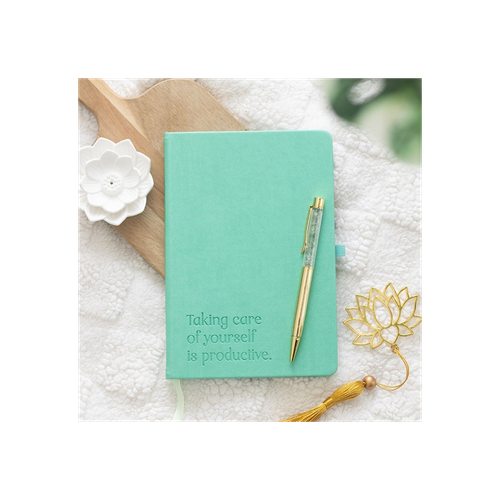
Encourage reflection and positive daily habits with this A5 wellness journal, complete with an aventurine crystal pen for an added thoughtful touch. Inside, printed guided pages support gentle morning and evening check-ins and mood tracking, helping to create a consistent and calming self-care routine. Ideal for journaling after yoga practice or setting mindful goals, it makes a meaningful gift for anyone focusing on wellbeing and personal growth.
