The Wheel of the Year: A Journey Through the Seasons
There is something beautiful about slowing down and noticing the rhythm of the natural world.
The changing light, the first signs of spring, the abundance of summer, the falling leaves and the quiet darkness of winter all invite us to pause and reconnect with the seasons.
For many modern Pagans and people following nature-based spiritual paths, the Wheel of the Year provides a way of doing exactly that.
The Wheel of the Year is a cycle of eight seasonal festivals, often called Sabbats. Together, they mark the solstices, equinoxes and the four festivals that fall between them. Different Pagan traditions celebrate these festivals in different ways, and some observe only certain points of the Wheel.
Rather than seeing the year as simply a calendar, the Wheel encourages us to experience it as a cycle of growth, abundance, release, rest and renewal.
Imbolc - Awakening
Around the beginning of February, Imbolc marks a turning towards spring.
The days are slowly becoming lighter, and although winter may still be very much present, there are signs that something is beginning to stir.
Imbolc is often associated with fire, candles, cleansing and new beginnings. It can be a beautiful time to ask:
What is beginning to awaken within me?
What dreams, ideas or intentions are ready to receive some warmth and attention?
Ostara - Balance & New Life
The Spring Equinox brings a moment of balance between light and darkness.
Spring begins to make itself visible through new growth, flowers, birdsong and longer days.
Ostara is often connected with renewal, fertility, balance and new beginnings.
It is a wonderful season for planting — both literally and metaphorically.
What would you like to grow this year?
Beltane - Celebration & Blossoming
By the beginning of May, spring has transformed into something much more vibrant.
The earth is green, flowers are blooming and life feels full of movement.
Beltane is traditionally associated with fire, fertility, vitality and the celebration of life. In modern Pagan practice, it can be a joyful opportunity to embrace creativity, connection, passion and abundance.
This is a time to celebrate being alive.
What brings you joy? What are you ready to fully embrace?
Litha -The Height of Light
Litha marks the Summer Solstice — the longest day and shortest night of the year in the Northern Hemisphere.
The sun is at its strongest and the natural world is bursting with life.
This part of the Wheel invites us to celebrate warmth, vitality, confidence and abundance while remembering that the cycle is always turning. After the longest day, the light gradually begins to fade again.
Where are you experiencing abundance in your life right now?
Lughnasadh - The First Harvest
As summer begins to shift towards autumn, Lughnasadh, also called Lammas in some traditions, marks the beginning of the harvest season.
It is a time to recognise the results of what has been planted and tended.
The harvest is not only about crops. We can also consider the things we have worked towards — skills we have developed, relationships we have nurtured and goals we have patiently grown.
What are you harvesting from the seeds you planted earlier in the year?
Mabon - Gratitude & Balance
The Autumn Equinox brings another moment of balance between light and darkness.
The abundance of summer begins to fade, leaves change colour and the natural world starts preparing for winter.
Mabon is commonly associated in modern Pagan practice with the harvest, gratitude and reflection.
It encourages us to notice what we have received and to appreciate what has sustained us.
What are you grateful for?
And perhaps just as importantly:
What are you ready to let go of?
Samhain - Release & Remembrance
Samhain marks the end of the harvest and the beginning of the darker part of the year.
It is often observed as a time for remembrance, reflection and honouring ancestors and those who have died. In many modern Pagan traditions, it is also considered an important threshold in the Wheel of the Year.
Rather than fearing darkness, Samhain can invite us to sit with it.
To acknowledge endings.
To honour what has passed.
And to understand that endings are also part of the cycle that makes new beginnings possible.
What are you ready to release?
Yule - Returning Light
At the Winter Solstice, we reach the longest night of the year.
And then, slowly, the light begins to return.
Yule is celebrated in many modern Pagan traditions as a time connected with the Winter Solstice, renewal and the returning sun.
Winter can remind us that not everything needs to be constantly growing.
There are seasons for action, and there are seasons for rest.
Sometimes the most important thing we can do is become quiet enough to listen.
What needs rest in your life? And what small light are you ready to carry into the year ahead?
Living with the Wheel
You don't have to follow a particular Pagan tradition to find meaning in the changing seasons.
The Wheel of the Year can simply be an invitation to become more observant.
Notice the first snowdrops.
Feel the warmth returning to the air.
Watch the trees become full and green.
Gather the fruits of late summer.
Listen to the leaves beneath your feet.
Notice the quietness of winter.
The Wheel reminds us that life is not a straight line.
There are beginnings and endings.
Growth and rest.
Light and darkness.
Abundance and release.
And perhaps the greatest lesson is that every season has its purpose.
You don't have to bloom all year.
Sometimes you are planting.
Sometimes you are growing.
Sometimes you are harvesting.
And sometimes you simply need to rest.
The Wheel keeps turning and so do we.
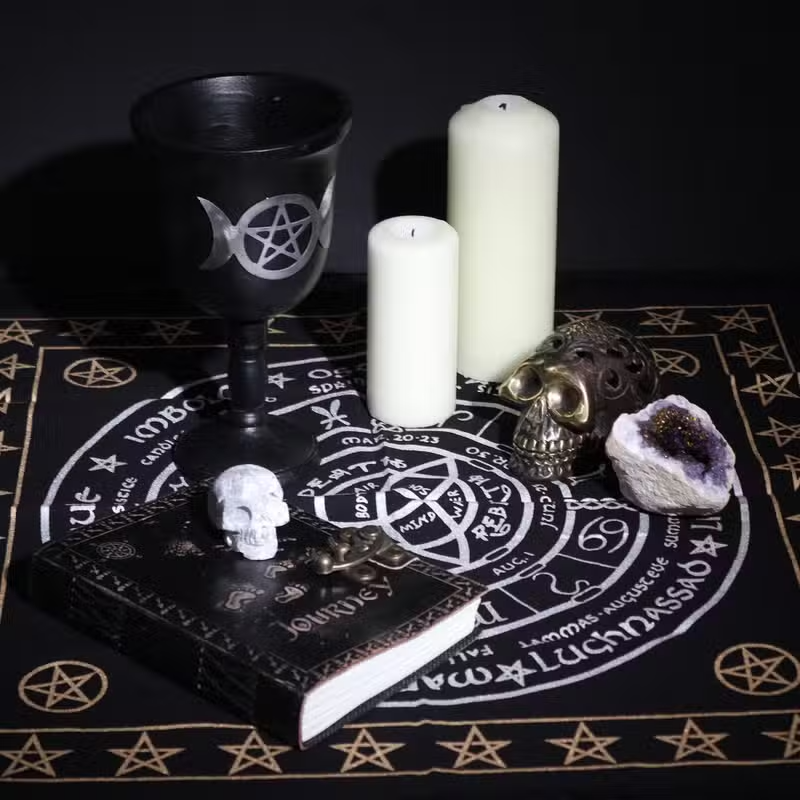
Honour the sacred cycles of existence with our Esoteric Fringed Altar Cloth featuring the Life Death Rebirth design. Crafted from cotton and finished with an elegant fringed border, this 50 x 50cm cloth is the perfect size to ground your spiritual practice.
The Life Death Rebirth motif serves as a powerful focal point, connecting your rituals, tarot readings, or meditations to the eternal rhythm of transformation, renewal, and spiritual evolution.
